




Caregiver juggles dad’s dementia, husband’s lupus, family and job
Jennifer Cortes copes with her dad’s dementia, her husband’s lupus, raising her children and a job in Rochester, New York.
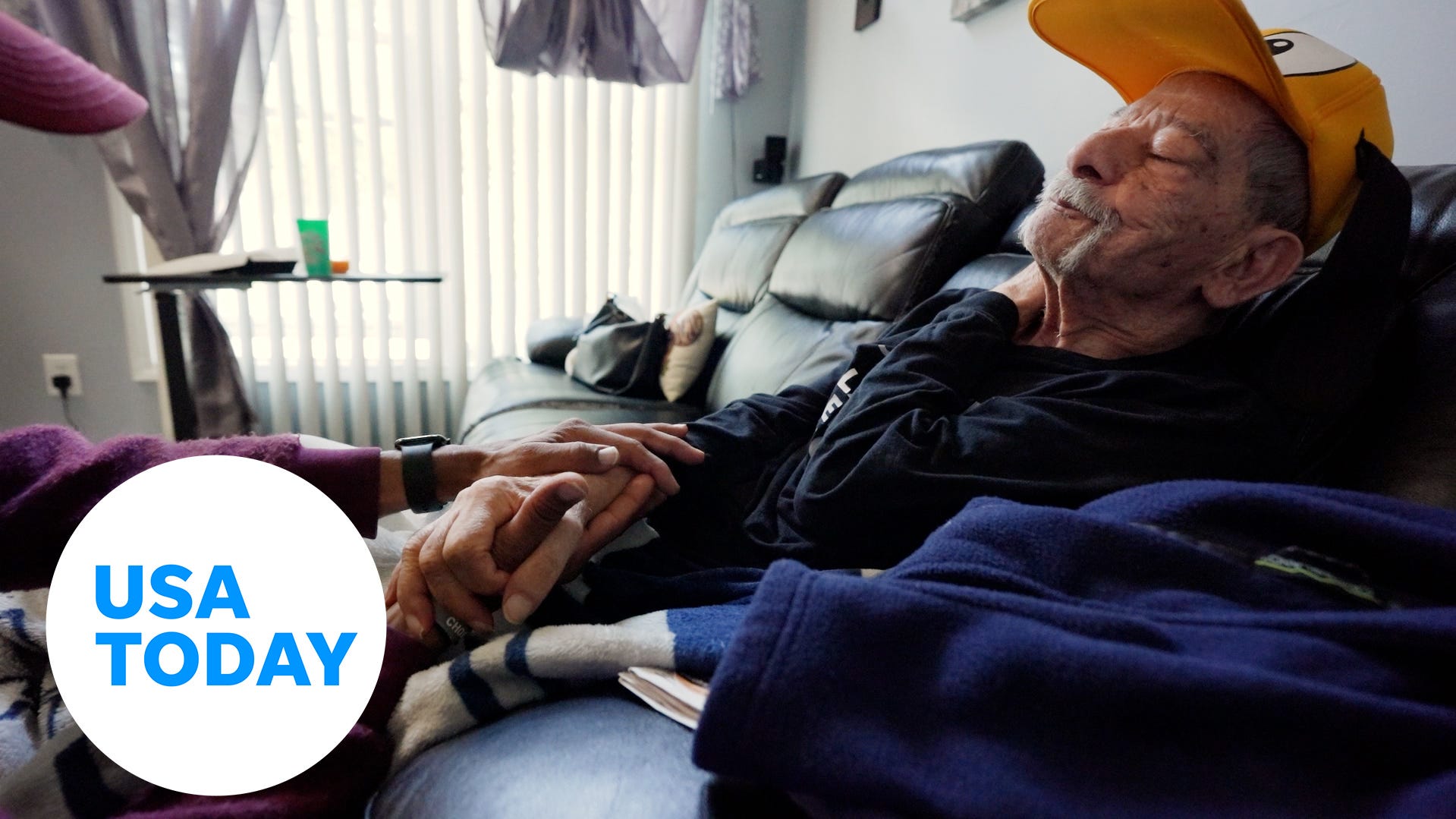
Jennifer Cortes, 39, walks across the hall to her father’s bedroom each morning to get him ready for the day. His bedroom walls are painted blue, with street signs from the “Cars” movie franchise – the remains of Cortes’ son’s middle school obsession.
Her son only enjoyed the signs for a little while before his grandfather moved in in 2017.
Cortes’ dad, 82-year-old Julio Rivera, has COPD, diabetes and late-stage vascular dementia. He has a home health aide who helps him bathe and eat, providing assistance for two hours three days per week, but otherwise his care falls to Cortes and her husband, Ismael Cortes Sr. Their two adult sons help out sometimes, too.
But even when the paid caregiver is there, Cortes can’t fully relax. The home health aide doesn’t speak Spanish, despite Cortes asking for a Spanish-speaking caregiver, and Rivera doesn’t speak much English. Cortes translates for her father while the aide is around, instead of taking a break.
“We’re supposed to be able to step away,” Cortes said, noting that the paid caregiver is trying to learn words in Spanish but still needs significant help. “She does her best.”
Between working full time, caring for her father and supporting her husband and sons, Cortes is stretched thin. Other women in the sandwich generation report similar feelings of loneliness and overwhelm, scrambling for a break. While nearly 40% of family caregivers say respite care would be helpful, only 13% use it, according to the 2025 Caregiving in the US Report from AARP and the National Alliance for Caregiving. The resource is still too scarce to support every family who needs it and, like in Cortes’ case, sometimes the family-provider match doesn’t address a family’s needs.
Some experts fear the rise of anti-immigrant rhetoric and deportations could further exacerbate the home health care shortage.
Cortes’ need for a break is compounded by the care she provides her husband, who left his job to help with Julio Rivera’s care but was diagnosed with an autoimmune disease in 2019.
Anti-immigration rhetoric and deportations could have big impact on care industry
Respite care, a program providing temporary relief and breaks from caregiving duties, was the most sought-after service among family caregivers in the AARP’s recent survey. About 1 in 3 home care workers, including aides who provide respite services, are immigrants, according to a Kaiser Family Foundation analysis of the 2023 American Community Survey. The foundation found immigrants make up 28% of the country’s direct long-term care workforce.
A 2024 study from Harvard Medical School found immigrant caregivers are essential to address the growing aging population in America. Nursing homes in regions with more immigrant caregivers were associated with better patient care, the study found.
There are a large share of immigrants working in child care, too, said Julia Gelatt, an associate director at the Migration Policy Institute. And with all care industries experiencing shortages, America can’t afford to lose immigrant workers to deportations and fear, Gelatt said.
“Losing workers out of those critical industries can make the cost of care more expensive. It can also lead U.S. born workers to drop out of the workforce to do the care themselves,” Gelatt said. “Usually, that’s women.”
This is backbreaking work, and workers in these roles aren’t getting paid nearly enough, said Jasmine Tucker, vice president for research at the National Women’s Law Center. They do it, oftentimes, to support their families and because they can’t find other work. And with America’s growing aging population, she said, the country needs more care workers, not less.
“You can’t automate care for people,” Tucker said. “You need people to take care of people.”
Language barriers add another layer of complexity for caregivers
Immigrants in America are aging, too, Gelatt said, and they have diverse language needs.
But not all regions have equal access to bilingual care workers, Gelatt said. In Monroe County, New York, where Cortes and her father live, about 6% of households speak Spanish, according to the United States Census Bureau, and 14% speak a language other than English. At the University of Rochester Medical Center, where Julio Rivera receives care, more than 230 out of the center’s 3,000 providers speak a language other than English. The center did not have information on how many providers speak Spanish. The center tries to provide every patient a caregiver who speaks their language “to the greatest extent possible,” the center wrote in a statement to USA TODAY.
When the center can’t match a provider with a patient’s preferred language, they work to find translation services either in person or via telephone or video. Patients can search for a provider who speaks their language on their website.
A 2023 report from Common Ground Health and the Latino Health Coalition found Latinos in the Finger Lakes region of central New York face worse health outcomes partially because of a lack of bilingual health care workers and culturally responsive health care.
With few Spanish-speaking health providers and translating services in the region, family members like Cortes often step in to translate for older adults at doctor visits, the report found, which can be harmful since important information can be lost through translation if the interpreter isn’t knowledgeable of medical terms. Cortes said her dad − who has never had a Spanish-speaking physician in Rochester − used translation services with his doctors when she couldn’t be there, before his dementia diagnosis.
Cortes said they were helpful “to a degree,” but said, “I don’t think anyone was ever speaking up for him and for his care.”
Cortes said the language barrier has not impacted the quality of her dad’s care, which she called “phenomenal.” She just can’t take a break.
‘No one prepares you’ for realities of caregiving, dementia
Cortes said her dad’s dementia has progressed in the last year. He still lets her know sometimes when he’s hungry or needs to use the restroom, but their conversations are limited. His food needs to be pureed, since he forgot how to swallow.
“There’s not a moment or an hour that can go by without something that needs to be done for him,” Cortes said. “Whether it’s getting him a snack or getting him some coffee or getting him some juice, or just making sure that he’s OK or comfortable.”
Sometimes, he doesn’t remember who she is.
“No one prepares you,” Cortes said. “It’s really tough to say my dad has been gone a long time.”
Still, Cortes tries to stay positive. She’s proud that while caregiving and working full time, she was also able to complete a bachelor’s degree in 2025. In one of her college papers for a gerontology class, Cortes wrote about caregivers’ mental health and respite needs.
Caregivers need help “so that they are not the only ones carrying the full burden on their own,” Cortes wrote. “It can be very easy to forget to care for yourself while caring for others.”
Madeline Mitchell’s role covering women and the caregiving economy at USA TODAY is supported by a partnership with Pivotal and Journalism Funding Partners. Funders do not provide editorial input.
Reach Madeline at memitchell@usatoday.com and @maddiemitch_ on X.
link